For independent clothing brands, solo entrepreneurs, and new apparel startups, MOQ (Minimum Order Quantity) is one of the most critical and confusing terms in the custom T-shirt OEM industry. Many emerging brand owners face huge operational barriers due to a lack of understanding of factory MOQ rules, including overstocked inventory, unnecessary cost waste, and failed product trial sales. Unlike large-scale clothing enterprises that can afford bulk order production, independent brands rely heavily on flexible, low-threshold small-batch customization to test market trends, build brand styles, and control operational risks. This guide fully explains what T-shirt OEM MOQ is, the differences between regular and small-batch MOQ models, the core benefits of low-MOQ customization for independent brands, and actionable strategies to negotiate and optimize small-batch orders, helping new apparel businesses run custom T-shirt projects more efficiently and stably.
1. What Is MOQ in Custom T-Shirt OEM
1.1 Core Definition of MOQ
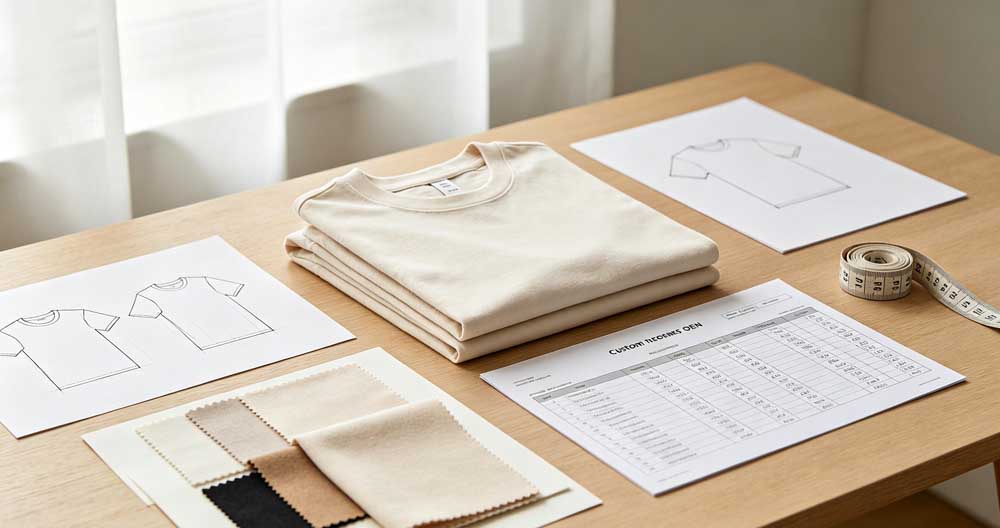
MOQ, short for Minimum Order Quantity, refers to the minimum number of products that a garment factory requires a client to order in a single customized production batch. It is a basic production threshold set by OEM manufacturers based on production costs, material procurement rules, and process scheduling. For custom T-shirt manufacturing, every factory has its fixed or flexible MOQ standard, covering blank garment base orders, printing and embroidery process orders, and personalized accessory customization orders. Factories set MOQ to ensure basic profit margins for each production order, reduce production resource waste caused by scattered small orders, and stabilize overall production efficiency. For independent brands with limited capital and unstable order demand, MOQ directly determines the feasibility, cost, and risk of custom T-shirt customization projects.
1.2 Regular MOQ vs Small Batch Low MOQ
The custom T-shirt manufacturing industry is divided into two mainstream order modes: regular bulk MOQ and small-batch low MOQ, which are completely different in order threshold, production cost, delivery cycle, and applicable brand scenarios. Traditional regular MOQ usually requires 100 pieces, 200 pieces, or more per style, which is tailored for mature large clothing brands with stable sales channels and large market demand. This mode has a low unit price but high overall investment and huge inventory pressure, completely unsuitable for new independent brands. In contrast, small-batch low MOQ usually supports 10 to 50 pieces per style, and some flexible OEM factories even support single-digit trial orders. Although the unit production cost is slightly higher, it greatly reduces the initial investment threshold and inventory risk, perfectly matching the market trial and small-scale operation needs of independent clothing brands.
1.3 Why Factories Offer Small Batch MOQ Options
Many new brand owners wonder why professional garment factories are willing to accept low-threshold small-batch T-shirt orders despite lower single-order profits. In fact, small-batch MOQ customization is a win-win business model for both factories and independent brands. For OEM manufacturers, small-batch orders can make full use of idle production equipment and spare production time, improve the overall utilization rate of production resources, and accumulate long-term potential brand clients. Most growing independent brands will gradually expand order quantities after verifying market demand, forming stable long-term cooperative relationships with factories. For brand side merchants, small-batch MOQ completely solves the core pain points of high entrepreneurial risk and inflexible ordering rules, enabling zero-pressure product trial sales and brand layout without worrying about unsold overstocked products.
2. Key Benefits of Small Batch Custom T-Shirt Orders for Independent Brands
2.1 Minimize Inventory and Financial Risks
Inventory backlog is the biggest killer of emerging independent clothing brands. Most new brands fail not because of poor product design, but because of blind bulk ordering leading to unsold inventory and broken capital chains. Small-batch MOQ customization fundamentally avoids this problem by allowing brands to place small-quantity orders according to actual market demand and operational capacity. Independent brands only need to invest a small amount of capital to complete product production, which greatly reduces the threshold for trial operation. Even if individual styles have poor market feedback, the loss is controllable, and brands can quickly adjust design styles and product layouts without bearing huge inventory pressure, maximizing the safety of brand operation funds.
2.2 Support Flexible Market Testing and Style Iteration
The casual apparel market is updated rapidly, and consumer aesthetic preferences and trend demands change constantly. For independent brands that need to establish market competitiveness quickly, rapid style iteration is essential. Small-batch low MOQ orders allow brands to launch multiple new styles in a short cycle, test the market acceptance of different designs, colors, and processes through actual sales data and user feedback, and accurately lock in popular styles suitable for their own brand positioning. Brands can continuously optimize product details, upgrade printing and embroidery processes, and adjust version parameters according to market responses, realizing rapid product iteration. This flexible trial-and-error operation mode enables new independent brands to quickly adapt to market changes and form their own competitive product systems.
2.3 Lower Brand Startup and Operation Threshold
In the past, custom T-shirt OEM was only accessible for mature brands with strong capital strength, due to the high MOQ threshold of bulk orders. The popularization of small-batch customization completely lowers the entrepreneurial threshold of the clothing industry, allowing individual creators, small studio teams, and new independent brands to participate in customized apparel business. Small-batch orders do not require large-scale capital investment, do not occupy a lot of warehouse storage space, and do not need professional large-supply-chain operation teams. A small team or even a single entrepreneur can complete the whole process of product customization, sales, and operation, greatly reducing the time cost and economic cost of brand creation, and providing equal development opportunities for emerging independent clothing brands.
3. Common MOQ Types in T-Shirt Customization
3.1 Blank Garment MOQ
Blank garment MOQ refers to the minimum order quantity of pure-color, unprinted original T-shirt blanks, which is the most basic order threshold in customized production. Regular blank garment suppliers usually have higher MOQ requirements, while small-batch OEM factories support mixed batch ordering of different colors and sizes of the same style. This means independent brands can match multiple sizes and color schemes in a small batch of orders to meet the diverse purchasing needs of customers, without placing separate large orders for each color and size. Blank garment MOQ is the foundation of custom T-shirt production, and choosing a factory with flexible blank garment MOQ rules can greatly enrich brand product diversity.
3.2 Printing & Embroidery Process MOQ
In addition to blank garment MOQ, printing and embroidery processes have independent minimum order quantity standards, which are easily overlooked by new brands and lead to increased hidden costs. Traditional screen printing has a certain MOQ threshold due to the need for plate making, while new process technologies such as DTG direct injection, small-area heat transfer, and local embroidery support ultra-low MOQ even single-piece customization. Different processes have different small-batch adaptation effects: DTG direct injection is suitable for small-batch complex pattern customization with no plate making fee and low trial order cost; local embroidery is suitable for small-batch high-end logo customization with stable quality and high product texture. Understanding process MOQ differences can help independent brands select the most cost-effective customization scheme for small orders.
3.3 Custom Accessory MOQ
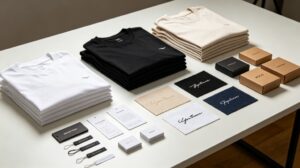
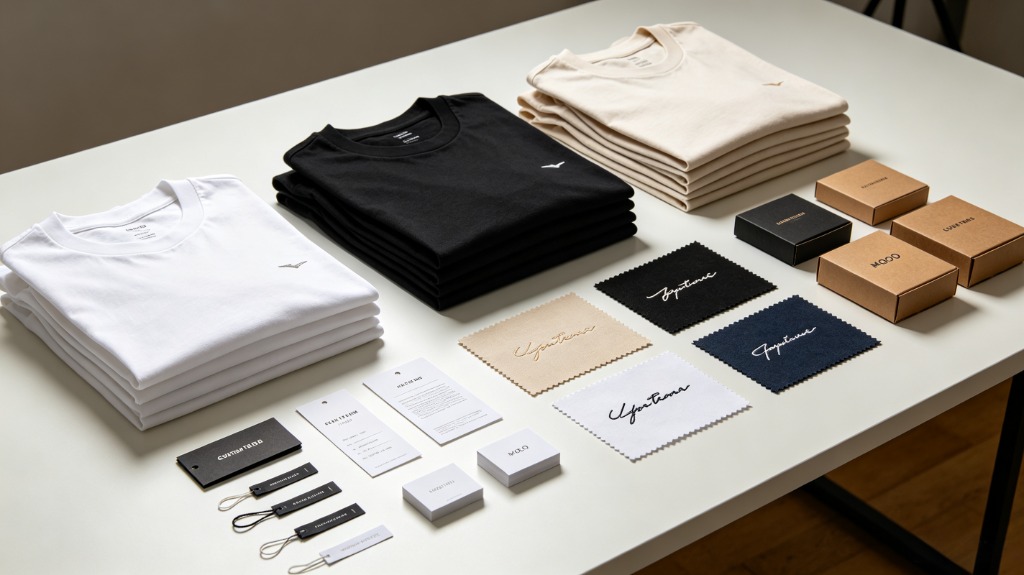
Brand personalized accessories including custom neck labels, size labels, washing labels, and packaging cartons also have their own MOQ rules. Many professional small-batch OEM factories support low-MOQ accessory customization for independent brands, avoiding the need to purchase a large number of labels and packaging materials at one time. Reasonable matching of low-MOQ accessory customization can make small-batch customized T-shirts have complete brand attributes and professional product texture, helping new brands shape a high-end brand image without increasing too much production cost.
4. Practical Tips to Get Better Small Batch MOQ Terms
4.1 Negotiate Mixed Batch Order Policies
Mixed batch ordering is the most practical skill for independent brands to break single-style MOQ restrictions. Most OEM factories allow mixed batch production of multiple colors, multiple sizes, and even multiple similar styles in the same order. Brands can disperse the total order quantity into different styles and colors, realizing multi-style small-batch trial sales without reaching the single-style high MOQ standard. Before confirming orders, brands need to actively communicate with factory merchants, confirm the factory’s mixed batch rules, maximize the diversity of order products, and optimize the richness of brand product lines under the premise of controlling total order quantity and cost.
4.2 Cooperate With Professional Small Batch OEM Factories
Ordinary large-scale garment factories focus on bulk orders and usually have rigid high MOQ thresholds, while professional small-batch custom T-shirt OEM factories are specially positioned to serve new independent brands and small studio teams. Such factories have optimized production processes, resource scheduling, and order rules for small-batch orders, with lower basic MOQ, more flexible order policies, higher proofing efficiency, and more friendly unit price for small orders. Long-term cooperation with fixed professional small-batch factories can also accumulate brand cooperation credit, further relax subsequent MOQ restrictions, and obtain more favorable quotation and delivery cycle privileges.
4.3 Balance Order Quantity and Unit Price Cost
There is a positive correlation between order quantity and unit price in T-shirt customization: the smaller the order quantity, the higher the single-piece production cost. Independent brands need to balance operational risk and profit space when placing small-batch orders. For core popular styles with stable customer groups and high repurchase expectations, appropriately increasing the order quantity can reduce the unit production cost and improve profit margins. For new trial styles with uncertain market feedback, strictly adhere to ultra-small-batch orders to control risks. This differentiated ordering strategy can maximize the comprehensive benefits of small-batch MOQ customization and realize stable brand profitability.
5. Common MOQ Mistakes New Independent Brands Make
In the process of small-batch custom T-shirt ordering, many new independent brands fall into MOQ-related pitfalls due to insufficient industry experience, resulting in increased costs and operational losses. The first common mistake is ignoring hidden MOQ rules, only paying attention to the surface style MOQ but ignoring the separate MOQ thresholds of processes and accessories, leading to temporary price increases and supplementary ordering. The second mistake is blindly pursuing ultra-low-quantity orders without considering unit price cost, resulting in excessively high single-piece cost and compressed profit space. The third mistake is failing to confirm mixed batch rules in advance, resulting in single-style order quantity exceeding actual demand and causing inventory backlog. In addition, some brands blindly believe in ultra-low-price small-batch orders, which often correspond to simplified processes and inferior fabrics, seriously affecting product quality and brand reputation. Independent brands need to avoid these common mistakes to standardize small-batch ordering operations.

6. Is Small Batch Low MOQ Customization Worth It
For mature large clothing brands with stable sales channels and huge order demand, bulk high-MOQ orders are definitely more cost-effective. But for all emerging independent brands, small-batch low MOQ customization is the most worthwhile and safest operation mode. Although the unit cost of small-batch orders is slightly higher, it saves huge inventory risks, reduces entrepreneurial trial-and-error costs, supports flexible market iteration, and helps brands quickly accumulate market experience and user groups in the early stage. The brand value and market feedback obtained from small-batch trial sales far exceed the slight increase in single-piece cost. For independent brands focusing on long-term operation and personalized brand building, low-MOQ small-batch T-shirt customization is the core supply chain strategy to achieve stable start and rapid growth.
MOQ is no longer a threshold restricting the development of independent clothing brands, but a flexible supply chain tool for brand market trial and product iteration. With the continuous improvement of the small-batch custom T-shirt OEM industry, low-threshold, flexible, and diversified small-order services have become the mainstream choice for new independent brands. By deeply understanding MOQ classification rules, reasonably using mixed batch ordering strategies, avoiding common industry pitfalls, and balancing cost and risk, independent clothing brands can make full use of small-batch custom T-shirt orders to complete brand initial layout, quickly iterate high-quality products that meet market demand, and finally build unique brand competitiveness in the fiercely competitive casual apparel market.