Screen printing and DTG direct-to-garment printing are the two most mainstream core printing crafts for custom T-shirts in the global apparel OEM market. Professional brand buyers and custom procurement merchants need to accurately distinguish the technical characteristics, finished effects and applicable scenarios of the two crafts, which directly determines product grade, cost control, retail reputation and after-sales rate. Many market homogenized products have unreasonable craft matching problems: using screen printing for complex gradient patterns resulting in distorted color layers, or using DTG printing for large-batch solid color orders leading to high cost and insufficient durability. As a professional custom T-shirt OEM factory, GreHex conducts in-depth professional analysis on the essential differences between screen printing and DTG direct printing based on long-term mass production and brand customization experience, providing accurate craft selection standards for industry professional buyers.
Basic Principle & Craft Flow Overview
The essential difference between screen printing and DTG direct printing lies in ink forming method and fabric penetration principle, which fundamentally determines their respective technical advantages and application limitations.
Screen Printing Principle & Process Screen printing is a traditional physical ink stacking craft. It uses a customized mesh screen plate. According to the pattern hollow-out area, the pigment ink is scraped and pressed through the mesh to attach to the fabric surface, forming pattern layers. Each independent color requires an independent screen plate, and the colors are superimposed layer by layer. The core process flow includes plate making, screen stretching, color mixing, manual scraping printing, high-temperature baking and curing. It belongs to physical covering printing, with obvious ink layer stacking characteristics on the fabric surface.
DTG Direct Printing Principle & Process DTG direct-to-garment printing is a digital inkjet penetration craft. It adopts professional textile digital printers, sprays water-based environmental protection ink directly onto the fabric fiber gap through high-precision nozzles, and completes color fixing through low-temperature heating. It does not require screen plate making, supports one-click printing of computer digital patterns, and realizes integrated penetration coloring. The ink penetrates into the fabric fiber instead of stacking on the surface, belonging to fiber infiltration printing.
Core Process & Finished Effect Differences
From the perspective of finished product texture, precision and three-dimensional sense, the two crafts have obvious differentiated characteristics, which are the key basis for professional style matching.
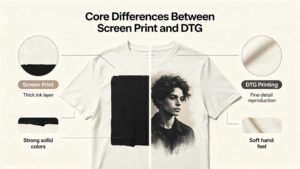
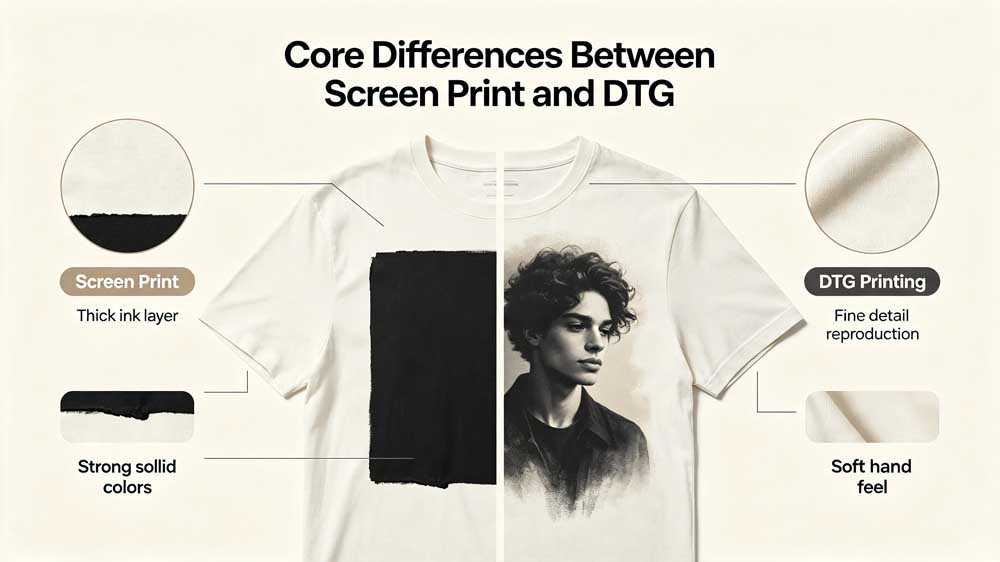
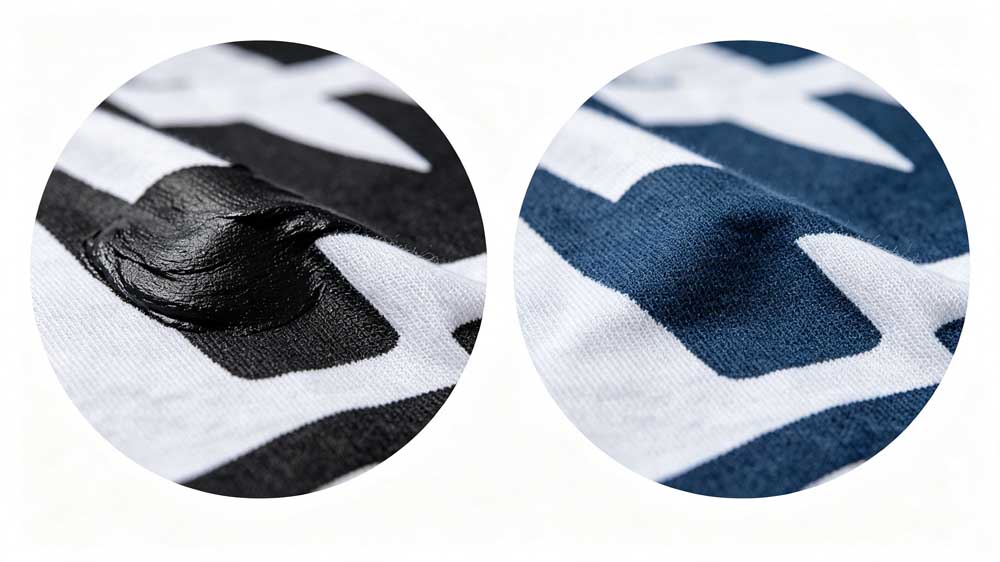
Surface Texture Difference Screen printing forms an obvious ink layer on the T-shirt surface, with a slight three-dimensional convex feel, thick and full color coverage, strong texture and excellent color saturation. The ink layer is tight and solid, with strong layering for solid color patterns. DTG direct printing ink penetrates into the fiber, the fabric surface is flat and smooth without stacking sense, completely restoring the original soft hand feel of cotton fabric, no hard rubber feeling, and the wearing fit is higher.
Pattern Precision & Color Layering Screen printing is limited by screen plate making, unable to realize ultra-fine lines, tiny gradient transitions and multi-color complex patterns. It is prone to jagged edges and color overlapping for delicate patterns. DTG printing supports unlimited color matching, natural gradient blur transition, portrait detail restoration and tiny line printing, with 100% pattern reduction accuracy and no color layering distortion, which is irreplaceable for complex artistic patterns.
Edge Fineness & Integrity Professional screen printing has neat pattern edges and strong color blocking sense, suitable for minimalist logo and geometric patterns. DTG printing has natural and soft pattern edges, no rigid boundary sense, and can realize seamless transition between pattern and fabric, with more artistic visual effect.
Fabric & Pattern Adaptability Comparison
Both printing crafts have strict fabric and pattern adaptation boundaries. Accurate matching can maximize product quality and avoid process defects.
Screen Printing Adaptability Screen printing is suitable for high-density pure cotton fabrics such as conventional ring-spun cotton and combed cotton, with low requirements for fabric flatness. It is perfectly compatible with large-area solid color patterns, single-color logos, geometric letter patterns and high-contrast color blocking designs. It is not suitable for ultra-fine gradient patterns, multi-color complex portraits and small-area dense detail patterns, which are prone to pattern distortion and rough edges.
DTG Direct Printing Adaptability DTG printing has high requirements for fabric flatness and purity. It is only suitable for high-quality pre-shrunk pure cotton fabrics (180GSM and above combed cotton is the best), and cannot be applied to polyester blended fabrics and low-density coarse cotton fabrics. It is exclusive for complex patterns: multi-color gradients, portrait illustrations, watercolor styles, tiny text details and irregular artistic patterns, with unique advantages in personalized complex custom styles.
MOQ, Cost & Production Cycle Difference
In actual brand procurement, MOQ threshold and cost structure are the core factors affecting order selection, and the two crafts have completely different cost logic.
MOQ Threshold Screen printing requires pre-production plate making, with fixed plate cost, so it is not suitable for ultra-small batch orders. It is cost-effective for medium and large batch orders, supporting stable mass production. DTG printing has no plate making cost and zero MOQ threshold, supporting 1-piece personalized customization and small-batch trial orders, which is very suitable for new brand style testing and limited-edition small-batch iteration.
Cost Structure Screen printing has high fixed plate making cost but low unit single-piece cost. The more the order quantity, the lower the average cost, with obvious mass production cost advantage. DTG printing has no fixed cost, but high single-piece unit cost, suitable for small-batch high-value customized orders, and the cost advantage disappears in large-batch orders.
Production Cycle Screen printing requires plate making, color calibration and batch scraping printing, with a longer pre-production preparation cycle but efficient mass production speed. DTG printing supports instant proofing and instant production, with ultra-fast proofing and small-batch delivery speed, greatly shortening the new product iteration cycle.
Washing Fastness & Durability Performance
For retail-oriented custom T-shirts, washing resistance and durability directly determine product after-sales rate and brand reputation, and the two crafts have significant performance differences.
Screen Printing Durability Screen printing adopts high-temperature baking and curing pigment ink, with thick ink layer and strong adhesion. After professional finishing, it can withstand more than 50 times of standard washing, with no ink peeling, no cracking and no fading. It has excellent tensile resistance and friction resistance, and will not be damaged by daily wearing and repeated cleaning, with long service life and stable retail quality.
DTG Direct Printing Durability DTG water-based ink penetrates into the fiber, with soft color fixing performance. It has good washing fastness for daily use, but compared with screen printing, the ink layer is thinner. Under frequent high-frequency washing and strong friction, slight fading may occur. Its overall durability is slightly lower than screen printing, and it is more suitable for light-use high-value customized products rather than long-term repeated wearing bulk retail products.
GreHex Professional Selection Suggestion
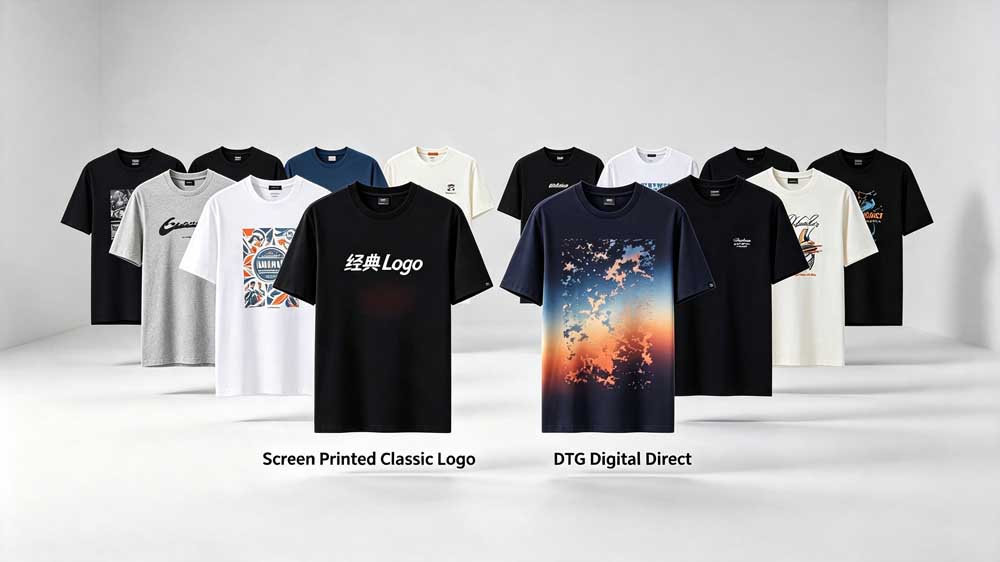
Based on OEM production experience serving global fashion brands, GreHex summarizes targeted craft selection schemes for different brand positioning and order demands, helping buyers avoid wrong matching and improve product competitiveness.
Choose Screen Printing If You Have These Demands Medium and large batch bulk orders, minimalist solid color logo customization, geometric letter patterns, high color saturation and texture requirements, long-term retail sales and high washing durability standards, corporate group uniforms and promotional clothing mass customization.
Choose DTG Direct Printing If You Have These Demands Small-batch trial sales and personalized customization, complex gradient patterns, portrait watercolor artistic styles, ultra-fine detail printing requirements, high fabric softness pursuit, limited-edition trendy products and designer exclusive custom styles.
GreHex Composite Craft Customization For high-end differentiated products, we support composite craft matching: partial screen printing for main logo texture + DTG printing for auxiliary gradient details, combining the three-dimensional texture of screen printing and the delicate detail performance of DTG printing, helping brands create exclusive high-premium customized products.
There is no absolute distinction between good and bad screen printing and DTG direct printing. The core of professional customization is reasonable scenario matching. Screen printing focuses on mass stability, texture three-dimensionality and washing durability, and is the preferred craft for bulk retail and group customization. DTG printing focuses on personalized refinement, complex detail restoration and low-threshold trial production, and is the core craft for brand new product iteration and high-end limited-edition customization.
As a professional T-shirt OEM printing factory, GreHex masters dual mature printing technologies. We do not blindly recommend single craft, but provide targeted professional craft matching solutions according to customers’ order quantity, pattern style, product positioning and sales scenarios, avoiding craft mismatch defects and cost waste. Whether it is large-batch screen printing mass production or small-batch DTG personalized customization, we can maintain retail-level finished product quality and batch stability.
Choose GreHex professional custom T-shirt printing service to obtain accurate craft selection, stable finished product effect and cost-controlled OEM solutions, and efficiently optimize brand customized product layout and market competitiveness.